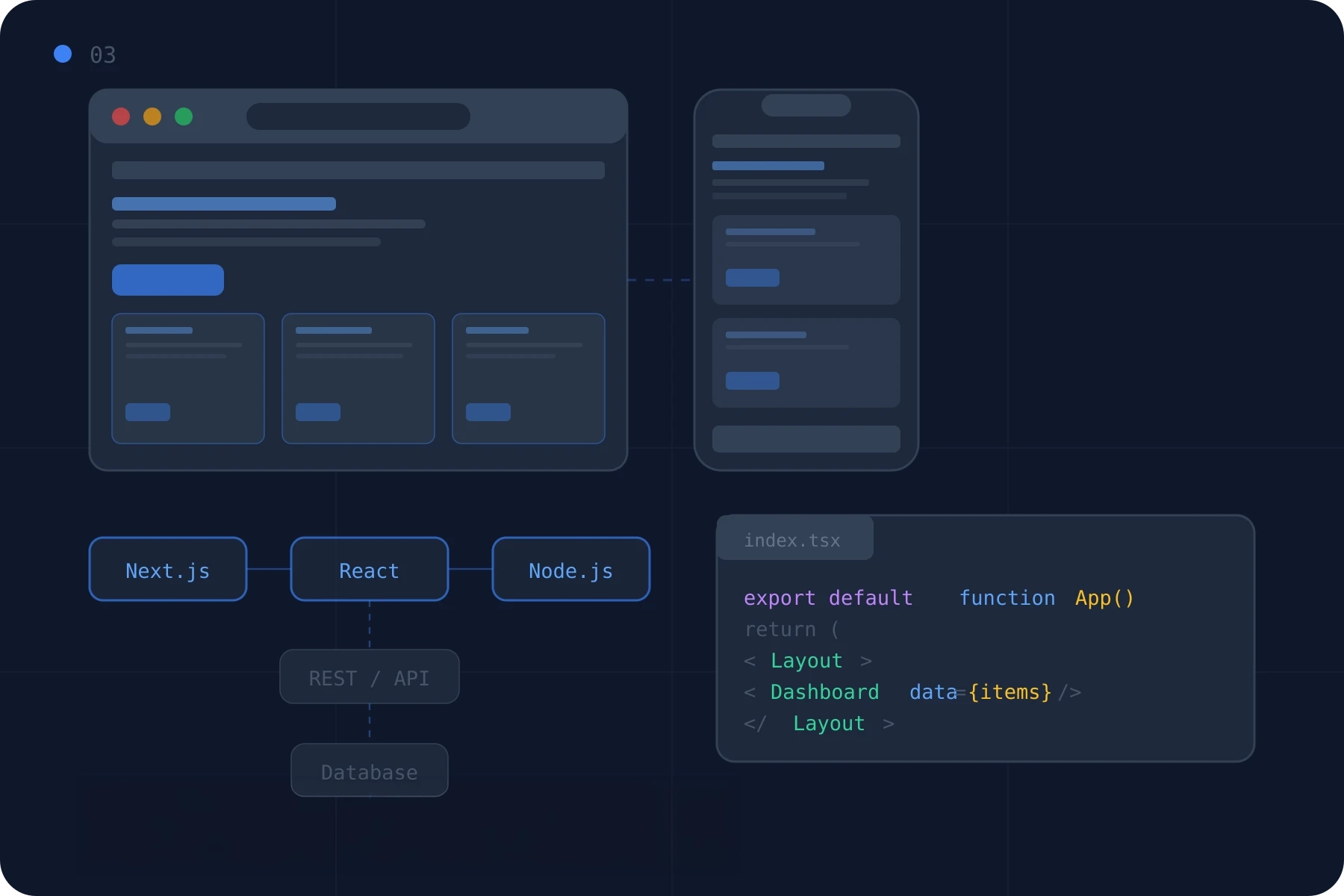
Applications Built for the Modern Stack
The line between web and native is disappearing. Users expect fast, fluid experiences whether they're on a phone, a tablet, a desktop browser, or a kiosk. Cryptic Arts Laboratory builds applications across all of these surfaces — with shared logic where it makes sense and native performance where it matters.
From single-page web applications and server-rendered sites to cross-platform mobile apps and progressive web applications, we deliver production-ready software that's responsive, accessible, and maintainable.
Web Applications
React and Next.js
React is the foundation of our web application work. We build with Next.js for projects that benefit from server-side rendering, static site generation, incremental static regeneration, and the App Router's streaming architecture. For client-heavy applications — dashboards, data visualization tools, interactive editors — we architect with React's component model, leveraging hooks, context, and state management patterns appropriate to the complexity of the application.
Vue.js and Nuxt
For teams with Vue.js expertise or projects where Vue's template-driven approach is the better fit, we build with Vue 3's Composition API and Nuxt for server-rendered and statically generated applications. Same engineering rigor, different framework.
Progressive Web Applications
PWAs bridge the gap between web and native — installable, offline-capable, push-notification-enabled applications that run in any modern browser. We implement service workers for intelligent caching and offline support, Web App Manifest configurations for home screen installation, and background sync for reliable data submission on unreliable networks.
Mobile Applications
React Native
When you need to ship on iOS and Android without maintaining two separate codebases, React Native delivers native performance with shared JavaScript logic. We build with React Native's New Architecture — Fabric renderer and TurboModules — for applications that need the smoothest possible animations and direct access to platform APIs. Navigation, state management, and data fetching patterns are chosen for the specific requirements of the project, not by default.
Native Platform Integration
Some features require native code. Camera access, Bluetooth communication, background processing, sensor APIs, and platform-specific UI patterns all benefit from native modules. We write Swift and Kotlin bridges when React Native's JavaScript layer isn't enough, ensuring the application feels native because the critical parts are native.
Expo and Managed Workflows
For projects where rapid iteration matters more than low-level platform access, we leverage Expo's managed workflow — over-the-air updates, simplified build pipelines, and a curated set of native modules that cover the majority of mobile use cases without ejecting.
Backend and API Development
Node.js and TypeScript
Our backend work is TypeScript-first. Type safety across the full stack — from database queries through API responses to frontend components — eliminates entire categories of runtime errors. We build with Express, Fastify, or Hono depending on the performance and deployment requirements of the project.
API Design
REST APIs with OpenAPI documentation, GraphQL for complex data requirements with multiple consumer types, and tRPC for end-to-end type-safe APIs when the frontend and backend are in the same TypeScript monorepo. We design APIs that are versioned, documented, and tested.
Database and Data Layer
PostgreSQL for relational data with complex query requirements. MongoDB for document-oriented workloads. Redis for caching, session management, and real-time features. Firebase and Supabase for projects that benefit from managed backend services. We choose the data layer based on the application's access patterns, not habit.
Engineering Practices
Responsive by Default
Every project starts mobile-first. Fluid layouts that adapt gracefully from phones to ultrawide monitors, with Tailwind CSS utility classes or CSS-in-JS solutions that keep styling colocated with components.
Accessibility First
WCAG 2.1 AA compliance is built into the process from the start. Semantic HTML, ARIA attributes, keyboard navigation, focus management, and screen reader testing — not an afterthought, but a design constraint that makes applications better for everyone.
Performance Obsessed
Bundle analysis, code splitting, lazy loading, image optimization, and caching strategies. We measure Core Web Vitals, profile rendering performance, and optimize the critical rendering path. If Lighthouse scores matter to you, they matter to us.