Accessible Deployment
Assistive technology that runs on hardware people already own.
The most powerful assistive technology is the one someone can actually use — not a lab prototype that needs a workstation, not a research demo that only runs on a specific GPU. We architect perception systems for the platforms that matter — smartphones, embedded boards, and browsers — under a strict deployment philosophy that puts the user's real hardware first.
Mobile-First Architecture
- Native iOS and Android with CoreML and NNAPI acceleration
- React Native for shared logic with native performance where it counts
- Camera, IMU, GPS, haptic, and speaker integration as first-class inputs
Smartphones are the most powerful computers most people own — and they have cameras, speakers, haptic motors, GPS, and IMUs built in. We build perception systems that run natively on iOS and Android, leveraging platform-specific acceleration (CoreML, NNAPI) and sensor APIs. React Native lets us share application logic across platforms while keeping native performance where it counts.
Embedded Edge Deployment
- Raspberry Pi for cost-sensitive deployments
- NVIDIA Jetson for GPU-accelerated inference
- Custom accelerators for specialized workloads
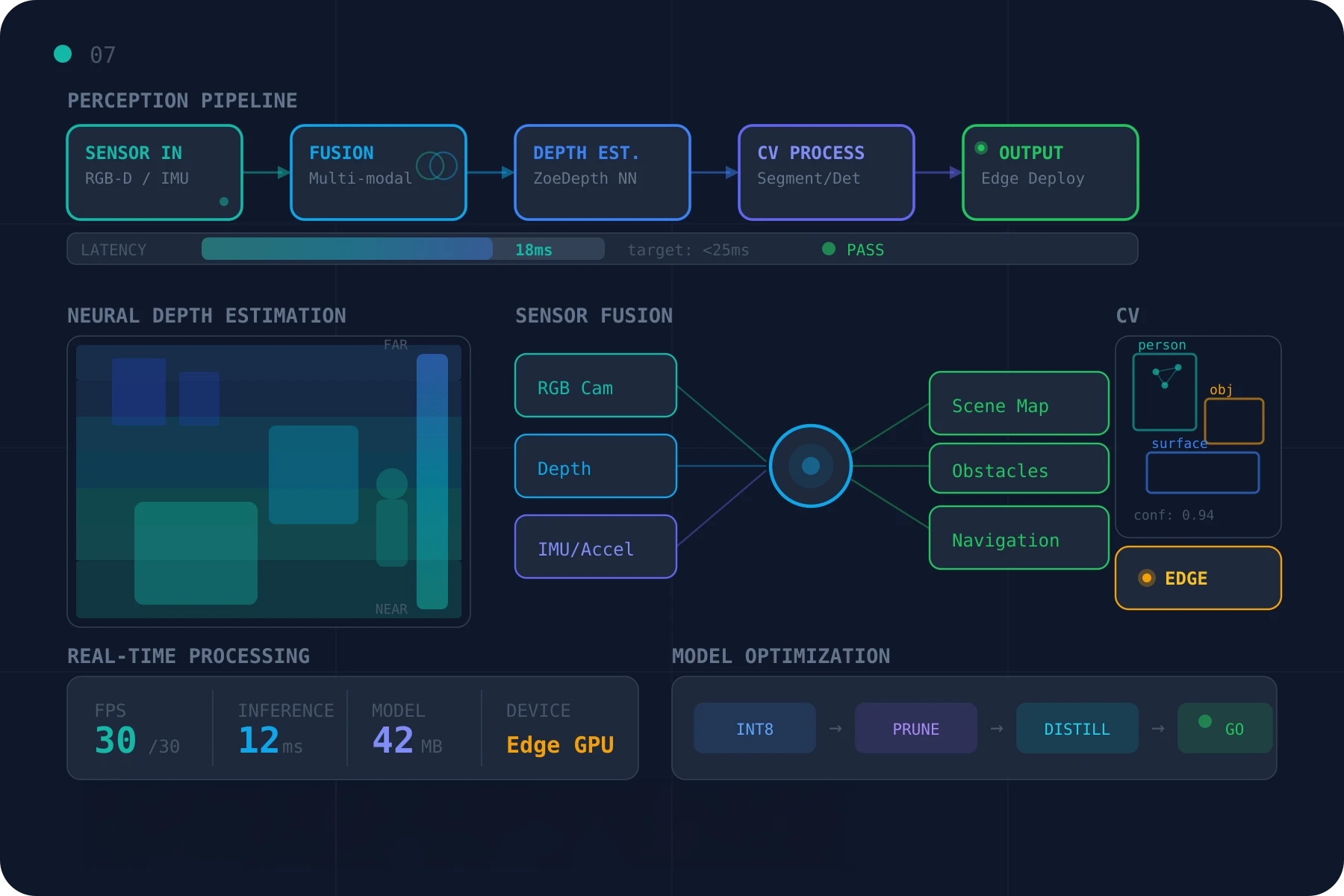
When a smartphone isn't the right form factor, we target embedded hardware — Raspberry Pi for cost-sensitive deployments, NVIDIA Jetson for GPU-accelerated inference, custom edge accelerators for specialized workloads. These systems run headless, boot in seconds, and operate for hours on battery power.
Browser-Based Systems
- WebGL and WebGPU for accelerated computation
- Web Audio API for real-time spatial audio synthesis
- Progressive Web Apps with offline operation
Sometimes the best deployment is no installation at all. WebGL provides GPU-accelerated computation, Web Audio API enables real-time spatial audio synthesis, and progressive web app patterns allow offline operation. We build perception systems that run entirely in the browser — accessible to anyone with a modern web browser, on any platform.
Minimal Footprint Engineering
- Production client bundles under 200KB
- Compressed models for mobile download budgets
- Progressive loading — core function first, enhancements later
Assistive technology often targets users with constrained bandwidth, storage, or data plans. We engineer for minimal footprint — production client-side bundles under 200KB, models compressed for mobile download, and progressive loading that delivers core functionality immediately while background-loading enhanced capabilities. If it doesn't run on a three-year-old Android phone, it doesn't ship.