Research Design
Experimentally rigorous systems built to validate.
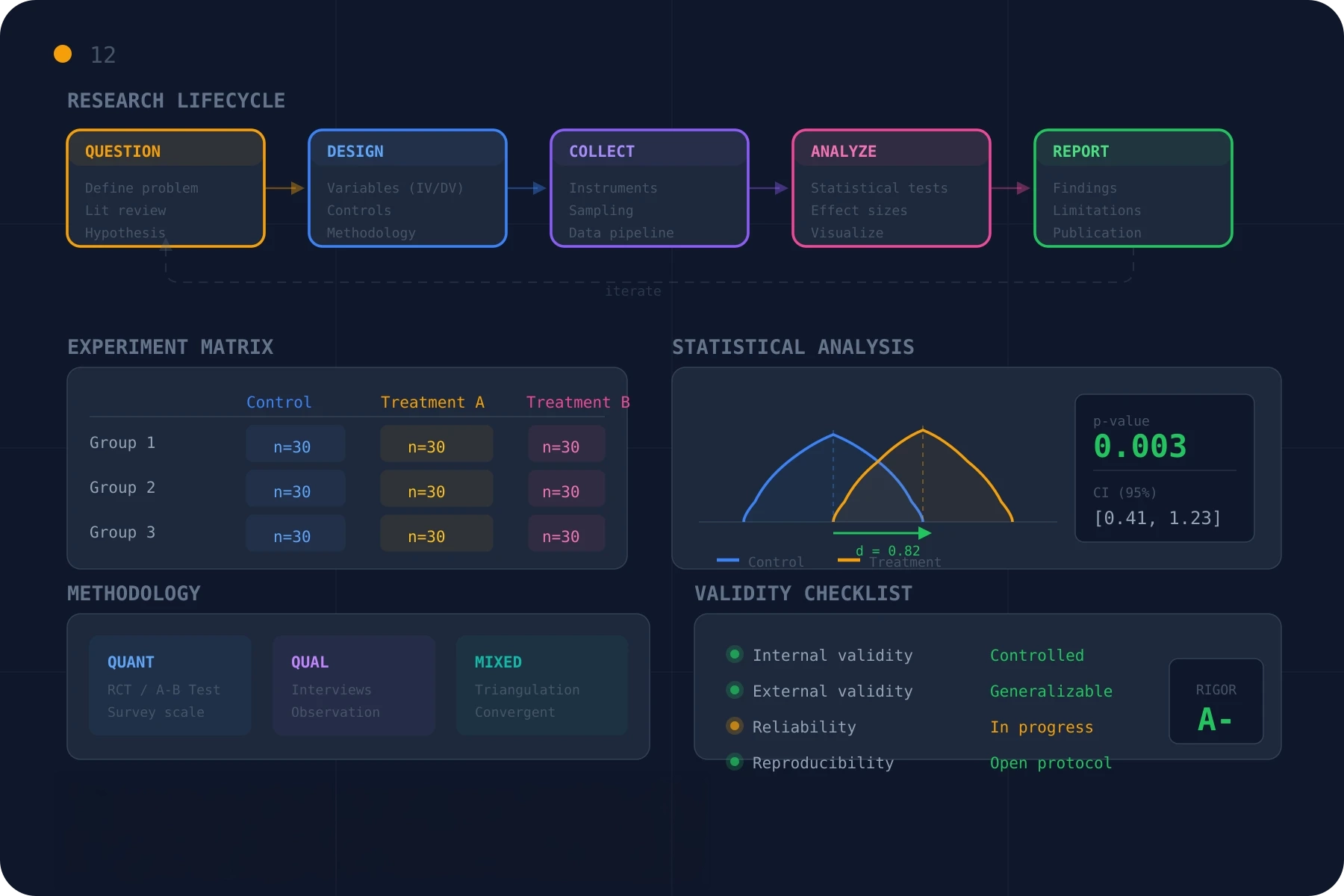
Novel perception systems require novel validation. It isn't enough to build something that works in a demo — you need evidence that it works for real users, in real conditions, compared against meaningful alternatives. We design systems with experimental comparison built in from the start, instrumented to produce publishable results and defensible design decisions.
Multi-Strategy Testing Frameworks
- Switch between strategies in real time, identical conditions
- Matched stimuli, counterbalanced ordering, automated conditions
- Same hardware, same environment, same participant — different approach
When you're exploring a design space — different sonification approaches, different depth representations, different interaction models — you need to compare them under identical conditions. We build frameworks that let you switch between strategies in real time, with matched stimuli, counterbalanced ordering, and automated condition management.
Real-Time Telemetry Systems
- Performance metrics — latency, frame rate, model confidence
- User behavior — navigation, response time, error rates
- Environmental context — lighting, noise, movement speed
Every interaction generates data. We instrument perception systems to capture performance metrics (latency, frame rate, model confidence), user behavior (navigation patterns, response times, error rates), and environmental context (lighting, noise level, movement speed). Telemetry streams to structured storage in real time, enabling live monitoring and post-hoc analysis.
User Study Infrastructure
- Accessible study platforms — screen reader, audio-first
- Configurable consent and debriefing flows, IRB-ready
- Participant recruitment and scheduling tools
Running user studies with assistive technology requires careful infrastructure — especially when participants include people with visual impairments. We build study platforms with accessible interfaces, screen reader compatibility, audio-first interaction patterns, and configurable consent and debriefing flows. The technology handles the logistics so researchers can focus on the science.
Publication-Quality Data Pipelines
- Cleaning, aggregation, statistical testing, visualization
- Reproducible scripts that generate publication-ready outputs
- Every analysis version-controlled, every figure regenerable
The path from raw telemetry to a figure in a paper is long and error-prone. We build pipelines that automate the journey — cleaning, aggregation, statistical testing, and visualization — with reproducible scripts that generate publication-ready outputs. Every analysis is version-controlled, every figure regenerable from source data, every statistical test documented.