Assistive Technology That Runs on Hardware People Already Own
The most powerful assistive technology is the one someone can actually use. Not a lab prototype that requires a workstation. Not a research demo that only runs on a specific GPU. Real technology, running on real hardware, in real people's hands — smartphones, tablets, embedded boards, and web browsers.
We architect perception systems for the platforms that matter: mobile devices people carry every day, embedded boards that fit in a pocket, and progressive web applications that work on any device with a browser.
What We Build
Mobile-First Architecture
Smartphones are the most powerful computers most people own — and they have cameras, speakers, haptic motors, GPS, and IMUs built in. We build perception systems that run natively on iOS and Android, leveraging platform-specific acceleration (CoreML, NNAPI) and sensor APIs. React Native lets us share application logic across platforms while keeping native performance where it counts.
Embedded Edge Deployment
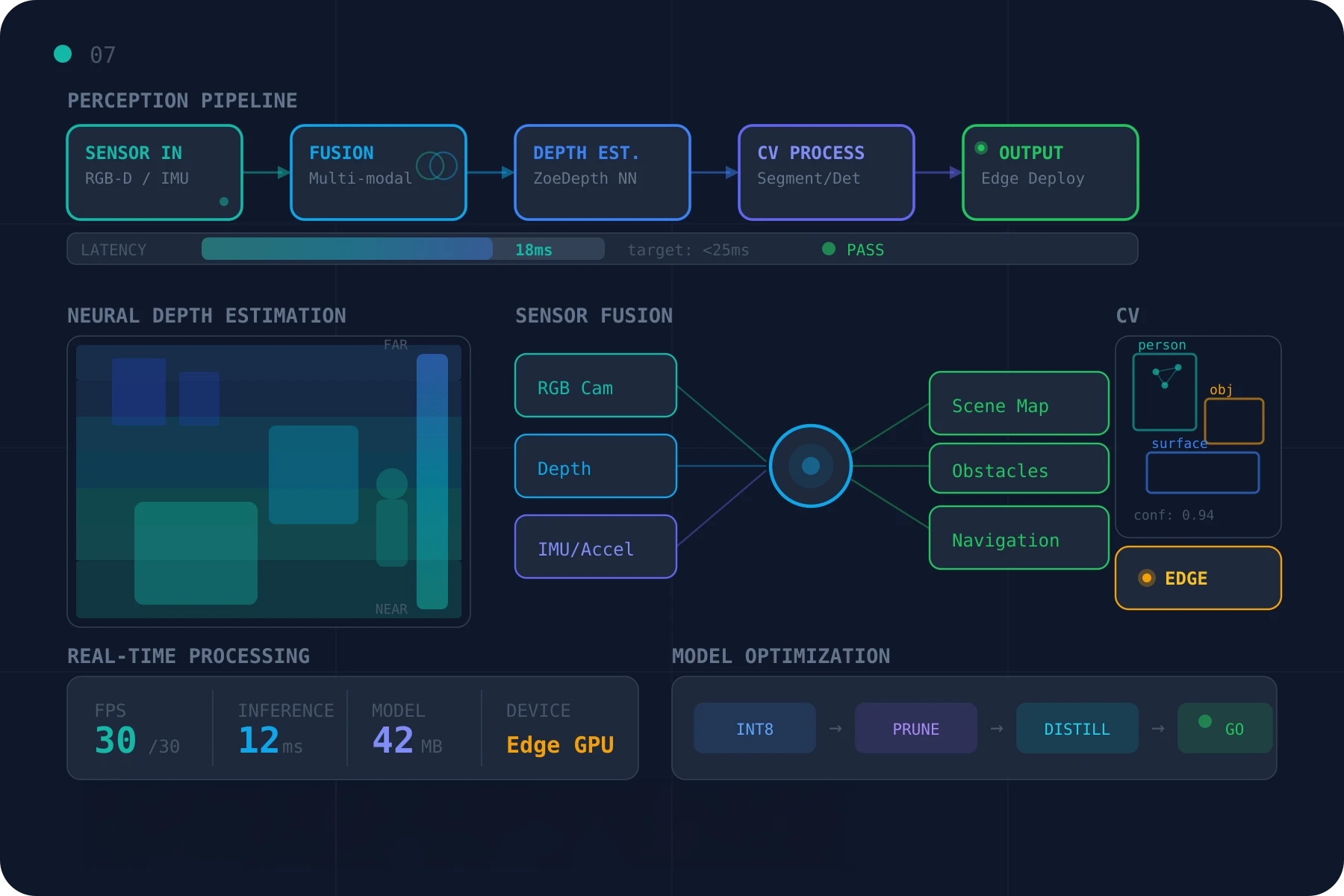
When a smartphone isn't the right form factor, we target embedded hardware: Raspberry Pi for cost-sensitive deployments, NVIDIA Jetson for GPU-accelerated inference, and custom edge accelerators for specialized workloads. These systems run headless, boot in seconds, and operate for hours on battery power.
Browser-Based Systems
Sometimes the best deployment is no installation at all. WebGL provides GPU-accelerated computation, Web Audio API enables real-time spatial audio synthesis, and progressive web app patterns allow offline operation. We build perception systems that run entirely in the browser — accessible to anyone with a modern web browser, on any platform.
Minimal Footprint Engineering
Assistive technology often targets users with constrained bandwidth, storage, or data plans. We engineer for minimal footprint — production client-side bundles under 200KB, models compressed for mobile download, and progressive loading that delivers core functionality immediately while background-loading enhanced capabilities.
Deployment Philosophy
The people who need assistive technology the most often have the least access to specialized hardware. Every architectural decision we make is filtered through this reality. If it doesn't run on a three-year-old Android phone, it doesn't ship. If it requires a fast internet connection, it needs an offline fallback. If it drains the battery in an hour, it's not an assistive tool — it's a demo.